
Black History Month
Honouring Presence, Brilliance, and the Work Still Required
Each February, communities across Canada observe Black History Month, a time to recognize the histories, contributions, and leadership of Black people whose presence on this land spans more than four centuries. It is a moment for reflection, but also for responsibility. Black History Month calls on us not only to remember, but to confront how the legacies of enslavement, segregation, and anti-Black racism continue to shape life in Canada today.
Black history in Canada is often misunderstood as marginal or recent. In reality, Black people have been present since the earliest periods of colonization. Enslaved Africans lived in New France and British North America. Black Loyalists, Jamaican Maroons, and refugees fleeing enslavement in the United States established communities, built institutions, and resisted oppression. These histories are not secondary to Canada’s story. They are foundational.
Black History Month was officially recognized by the Government of Canada in 1995 following sustained advocacy by Black leaders and communities. That recognition is owed in large part to the leadership of Jean Augustine, the first Black woman elected to Canada’s Parliament, who introduced the parliamentary motion to formally recognize Black History Month. Her work was supported and strengthened by historians, educators, and community advocates such as Rosemary Sadlier, whose decades of scholarship and public education helped ensure that Black Canadian histories were named, preserved, and shared nationally.
In 2026, Canada marks 30 years of Black History Month. The national theme, “30 Years of Black History Month: Honouring Black Brilliance Across Generations - From Nation Builders to Tomorrow’s Visionaries,” invites reflection on continuity. It connects early community builders and freedom-seekers with present-day leaders, artists, scholars, workers, and organizers who continue to shape the country. It affirms that Black history is living, intergenerational, and forward-looking.
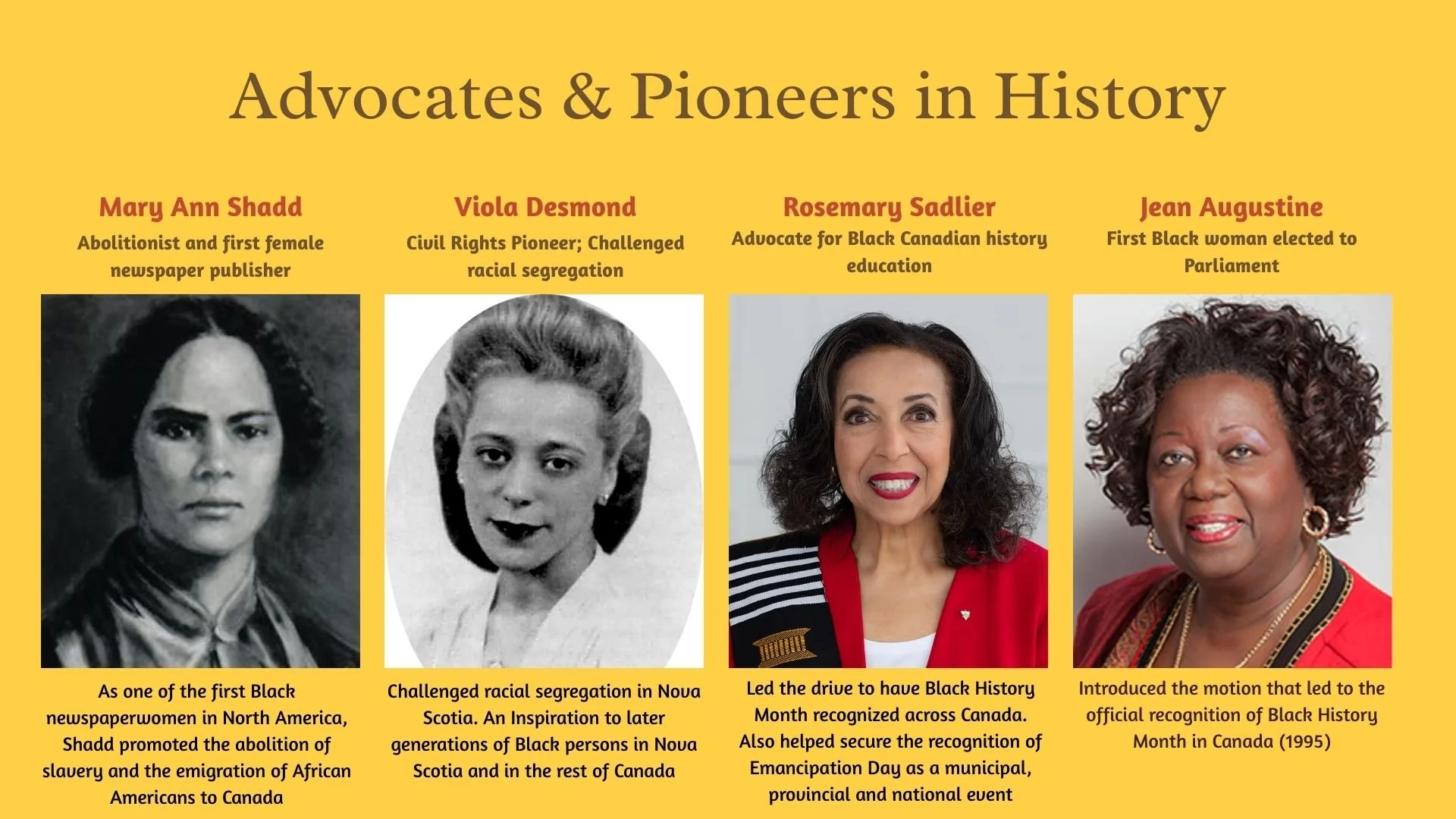
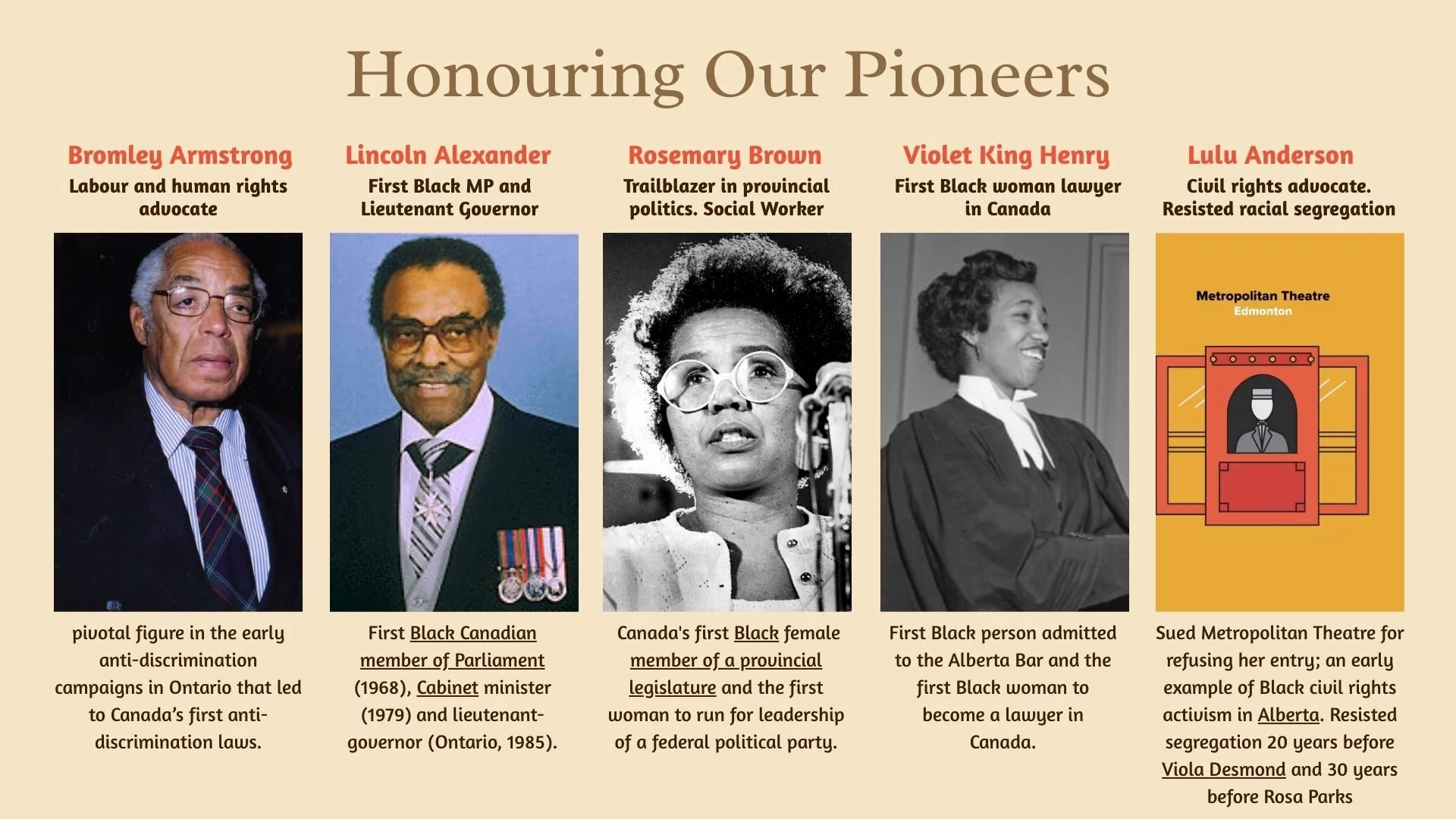
Honouring Black brilliance also requires acknowledging those who challenged injustice and expanded rights long before equity was widely named as a public value. Figures such as Viola Desmond, Mary Ann Shadd, Bromley Armstrong, Lincoln Alexander, and Rosemary Brown confronted segregation, labour exclusion, and political marginalization, often at great personal cost. Their advocacy laid the groundwork for many of the legal protections and public conversations that exist today.
In Alberta, Black brilliance and resistance are equally central to provincial history. Leaders such as Violet King Henry, the first Black woman lawyer in Canada and the first Black person admitted to the Alberta Bar, and Lulu Anderson, an early community organizer and advocate in Edmonton, challenged exclusion and discrimination in education, housing, and public life. Their legacies continue through Black-led organizations, cultural institutions, and community advocacy across the province.
At the same time, recognition alone is insufficient. Black Canadians continue to experience systemic barriers across multiple sectors. Disproportionate involvement in child welfare and the criminal justice system, persistent gaps in housing, employment, health outcomes, and education, and ongoing exposure to racial profiling and violence reflect the enduring impacts of anti-Black racism. National and international bodies, including United Nations experts, have repeatedly affirmed that anti-Black racism in Canada is systemic and deeply embedded.
Black History Month therefore serves as both remembrance and reckoning. It asks us to examine whose histories are centred, whose voices are amplified, and whose experiences shape policy, practice, and public understanding. It challenges institutions to move beyond symbolic acknowledgement toward structural change.
For social workers, educators, service providers, and community organizations, Black History Month reinforces the importance of anti-racist, culturally responsive, and equity-oriented practice. It calls for an honest examination of how systems may reproduce harm, even when intentions are well-meaning. It also underscores the importance of listening to Black communities, supporting Black-led organizations, and recognizing lived experience as a critical form of expertise.
Honouring Black brilliance means acknowledging resilience and achievement alongside struggle and resistance. It means telling the truth about Canada’s history of enslavement and exclusion, while also recognizing the creativity, leadership, and vision that Black communities continue to offer. It means understanding that justice is not achieved through recognition alone, but through sustained action, accountability, and collective responsibility.
Black history is Canadian history. While February provides a dedicated space for reflection, the responsibility to advance equity, dignity, and justice extends far beyond a single month. As we mark Black History Month in 2026, we are called not only to remember, but to act, with honesty, commitment, and care.
Evetta Solomon
Resources
About Black History Month - Canada.ca
Significant events in Black history in Canada - Canada.ca
Rosemary Sadlier | The Canadian Encyclopedia
Viola Desmond | The Canadian Encyclopedia
Jean Augustine | The Canadian Encyclopedia
Black History Month... by the numbers
Proud of our History - Black History Month
The Diversity of the Black Populations in Canada, 2021: A Sociodemographic Portrait
Addressing anti-Black racism - Canada.ca
Organizations and educational resources on the history of Black communities in Canada - Canada.ca